Drive
Electrical activation of breathing muscles, recorded directly with surface EMG (sEMG). This is an indicator of muscle activation, not a direct measurement of mechanical force or work of breathing.


REPHAEL connects synchronized physiological information for clinical review across hospital and home-care settings. Its development aims to support earlier recognition of change and greater care capacity.
Learn More ↗REPHAEL is predictive physiological infrastructure developed by ATLASense Biomed. PolyMonitor produces synchronized physiological information, shared with REPHAEL for clinical review. The same device serves many successive patients within the service workflow. It is included in the REPHAEL service, together with the cloud and applications. ATLASense retains ownership and full responsibility for the device.
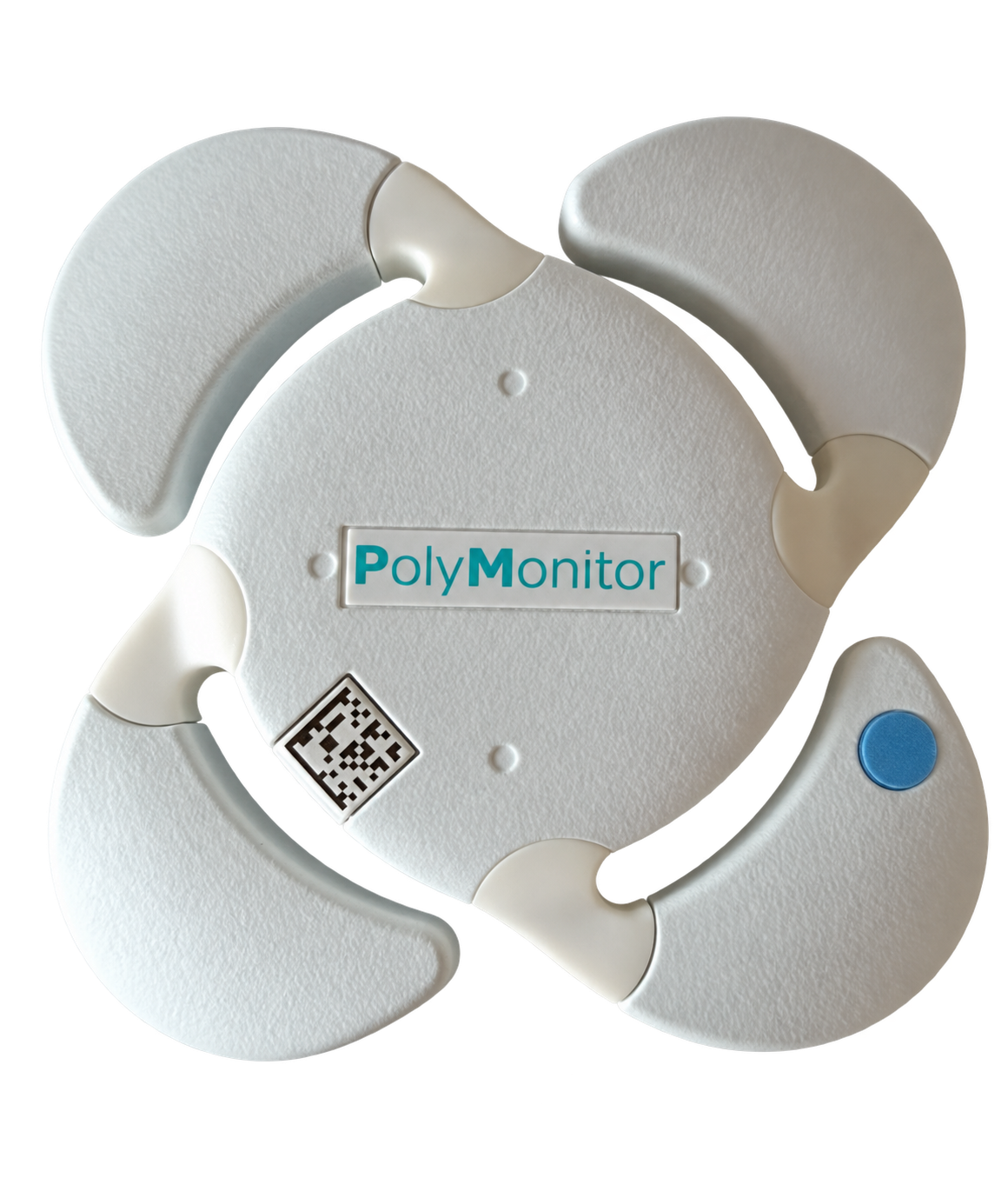

Physiological changes can occur between scheduled observations. REPHAEL is designed to add continuous trends to clinical review. Earlier recognition and intervention are development goals; care teams remain responsible for assessment and escalation.
Our mission is to expand treatment and hospital capacity with existing teams, without expanding workload or cost. Hospital-at-home is one major application of that broader ambition. Randomized studies support lower costs and broadly comparable clinical outcomes for selected patients. Read the hospital-at-home evidence ↗ Achieving that goal requires clinical selection, a usable review workflow, an escalation pathway and measured operational results.
Cloud applications and algorithms build on the same physiological foundation. Applications in development include 1–3-lead ECG and blood-pressure Holter, rhythm review, sepsis screening and early identification of respiratory deterioration. Each requires application-specific evidence and applicable regulatory clearance.
See how it works ↗ · Explore respiratory care ↗ · Review stakeholder value ↗
← Return to REPHAELREPHAEL / PolyMonitor PA5 holds Israeli Ministry of Health registration for defined use. The certificate signed June 3, 2026 is valid until December 31, 2026, subject to its conditions.
Its scope is restricted to four medical centers, with use by physicians trained and authorized by the manufacturer or its authorized representative. Commercial implementation must remain within this registered scope. Advanced applications have their own evidence and authorization requirements.
The October 2026 plan targets a first FDA 510(k) submission in October 2026 and clearance in Q2 2027; a CE MDR application in December 2026 and certification in Q3 2027; and a second FDA submission in March 2027 and clearance in Q4 2027. These are targets subject to financing, regulatory review and execution. Applications become available only within their authorized scope.
Discuss an implementation pathway ↗In development · Not approved for clinical use
REPHAEL is being developed to identify early physiological signs of respiratory deterioration, classify the patient’s respiratory state and offer clues to possible causes — continuously, in real time, in the ward and at home, from one chest-worn device.
Connect breathing-muscle activation with respiratory output and their changing relationship. The intended value is to make increasing effort, reduced efficiency or fading respiratory drive visible while considering the patient’s personal baseline.
For the team, the development goal is a clinical picture with state, trend, confidence and possible-cause clues, helping prioritize bedside review and follow changes through the transition from ward to home.
For patients, one chest unit can bring effort and breathing trends into the same follow-up process across care settings. For providers, that continuity can inform decisions about closer observation, discharge planning and escalation, alongside examination and complementary oxygen measurements.
Respiratory failure can develop over hours or days: breathing muscles work harder, breathing patterns change and the body compensates, sometimes until compensation fails. Some events develop rapidly. Intermittent checks can miss changes between observations; oxygen saturation describes oxygenation and can remain preserved despite impaired ventilation, particularly with supplemental oxygen. Routine observations usually do not quantify breathing-muscle activity. Earlier recognition could create an opportunity for assessment and timely intervention.
REPHAEL — ATLASense’s Predictive Physiological Infrastructure — connects three respiratory dimensions, relative to the patient’s own baseline.
Electrical activation of breathing muscles, recorded directly with surface EMG (sEMG). This is an indicator of muscle activation, not a direct measurement of mechanical force or work of breathing.
Breathing rate and relative breath amplitude, interpreted in the patient’s context.
The relationship between respiratory movement and muscle activation, tracked against the personal baseline.
Alongside breathing pattern, estimated reserve and heart–lung coupling, the development framework aims to distinguish stable breathing, compensated load, decompensation, pre-failure and declining breathing with little visible distress. These are proposed application states, not validated diagnostic categories.
The intended display combines state, trend, confidence and clues described as “consistent with”: airway obstruction, congestion or fluid, respiratory depression, muscle fatigue or anxiety. The aim is to guide what to check at the bedside; it does not establish the cause or replace clinical judgment.
Intended research populations include patients at risk of respiratory deterioration with COPD, heart failure, asthma, neuromuscular conditions such as ALS, weaning from ventilation, bronchitis, pneumonia or recovery from viral illness such as COVID-19 — in hospital wards, step-down units and hospital-at-home. Performance and intended use must be established for each population.
REPHAEL records respiratory muscle electrical activity through sEMG alongside synchronized respiratory and cardiac signals. This combination is intended to support assessment of loading, fatigue and respiratory change.
Historical respiratory physiology · these studies predate REPHAEL. Measurement studies using REPHAEL are presented separately below.
Electromyogram pattern of diaphragmatic fatigue
In five healthy volunteers under controlled respiratory loading, EMG spectral changes accompanied fatigue before pressure-generating failure. The study provides physiological background for assessing respiratory muscle activity.
Read the publicationClinical manifestations of inspiratory muscle fatigue
Six of 12 patients with difficult ventilator weaning showed EMG evidence of fatigue. The observed sequence linked electrical changes to subsequent changes in breathing pattern and arterial carbon dioxide.
Read the publicationCompany materials identify Ditza Gross and Carol Cohen as members of the ATLASense team. The publication records list D. Gross and C. A. Cohen.
Capabilities overlap. Sensor methods, timing, interpretation and service models vary by product. This comparison describes approaches; it is not a head-to-head performance study.
| Approach | What is measured | When information is available | What the team receives | Cost structure |
|---|---|---|---|---|
| Intermittent observations and early-warning scores | Respiratory rate, oxygen saturation, pulse and other observations. | At scheduled checks or when clinically indicated; changes between checks may be missed. | Observations, scores and escalation protocols. | Staff time and measurement equipment. |
| Continuous wearable sensors | Heart rate, respiratory rate, temperature and other signals; ECG or oxygen saturation in some products. Not all use optical sensing. | Continuous measurements or periodic updates, depending on the device and setting. | Trends, alerts and, in some systems, individualized interpretation. | Single-use and reusable models exist; adhesives, cleaning, service and staffing contribute to total cost. |
| Home symptom and oxygen monitoring | Questionnaires and oxygen saturation; other measurements may be included. | At reported checks or continuously in some configurations. | Threshold alerts, trends and clinical review, depending on the service. | Devices, connectivity and clinical follow-up. |
| REPHAEL · respiratory application | 19 recorded signal channels in the company’s description, including breathing-muscle electrical activity; no optical pulse sensing or SpO₂. | Continuous personal-baseline trends; earlier warning is a development objective to be tested. | Intended output: state, trend, confidence and possible-cause clues for clinical review. | Reusable device across successive patients; usage rights as a service, without purchasing the device. |
In hospital: the aim is continuous coverage of general wards and a patient list organized by state and trend. Reducing unplanned ICU transfers and failure-to-rescue events is an intended outcome. Staffing needs and clinical benefit require evaluation.
At home: the same physiological information framework can support review across care settings, alongside the clinical services required for hospital-at-home.
ADaaS — Actionable Data as a Service: usage rights without equipment purchase. ATLASense retains device ownership. Multi-patient reuse changes the equipment cost model; total cost also depends on consumables, cleaning, service and staff time.
These studies establish the physiological rationale. Translating it into a specific REPHAEL warning time, classification accuracy and clinical benefit requires evaluation of the integrated application in its intended patients and settings.
Company-reported foundation: ISO 13485 certification; 1,496 monitoring hours, including 849 against reference instruments; two granted patents and one allowed, pending issuance. These figures describe the company and measurement work, not validated respiratory prediction performance.
REPHAEL does not include optical pulse sensing and does not measure oxygen saturation. The respiratory application is intended to complement oxygenation and ventilation assessment, not replace them.