Select and fit
The clinical team selects suitable patients under the applicable intended use. PolyMonitor is attached to the chest with ECG electrodes, following the device instructions. Staff check skin contact and signal quality.


Care settings
Keep the team’s physiological view connected to home.
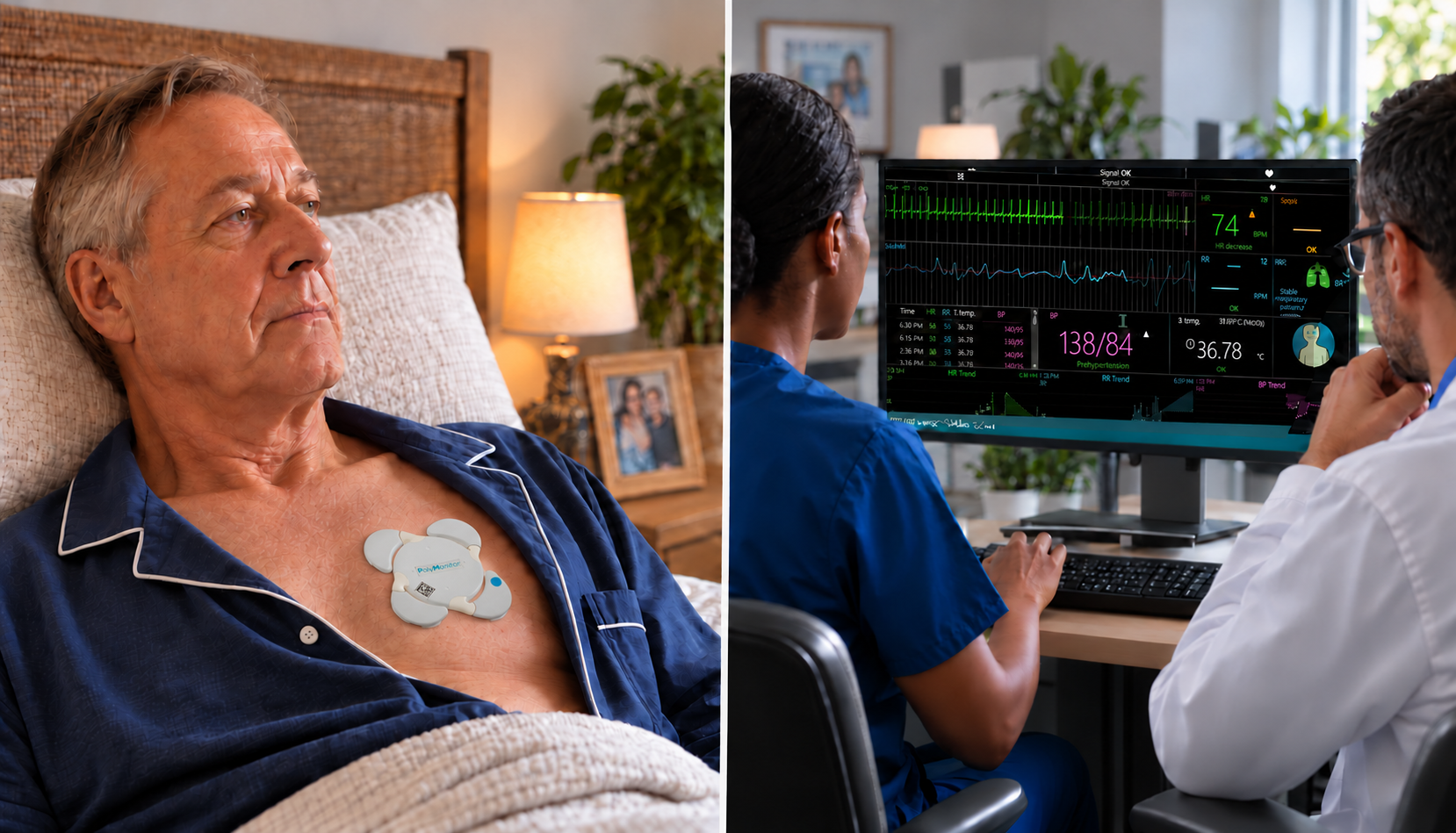
Hospital at home depends on suitable patients, clinical visits and a reliable response. Between visits, the team needs physiological context to assess changes and decide whether a home assessment or transfer is needed.
Before home admission, confirm the home connection and response plan. The patient wears PolyMonitor; REPHAEL presents the data to the responsible clinical team. Remote review complements visits, with escalation agreed for concerning change or loss of connectivity.
One synchronized physiological view
Selected for the care pathway
Synchronized chest signals
BLE data relay
Signal processing and fusion
Review, assess, respond
The clinical team selects suitable patients under the applicable intended use. PolyMonitor is attached to the chest with ECG electrodes, following the device instructions. Staff check skin contact and signal quality.
The chest unit acquires ECG, respiratory and other physiological signals. It connects to a gateway over BLE; the gateway relays the data to the REPHAEL cloud for processing and fusion. Agree connectivity, coverage and responsibility for interruptions at each site.
The team reviews synchronized signals and trends in the clinical interface, alongside bedside assessment and the care plan. Assign a responsible team, review schedule and escalation pathway before starting.
Provide physiological trends between visits, in the context of symptoms and clinical assessment.
Support a defined home-care service with remote review and an accountable response team.
Consider the full home-care episode: visits, logistics, connectivity and the monitoring service. Care-model research is not a measured saving from REPHAEL.
The intended benefits below describe the service design. Changes in outcomes, workload or cost require evaluation in the local care pathway.
Evidence for hospital at home
38% lower direct care costs
Levine and colleagues randomized 91 adults with selected acute conditions: 43 to home care and 48 to hospital care. Adjusted direct acute-episode costs were 38% lower at home (95% CI: 24–49%).
Thirty-day readmission was 7% versus 23%, and home patients were more physically active. The small, two-site trial combined home visits, treatment and remote monitoring.
20 randomized trials
A Cochrane review of 3,100 participants found that admission-avoidance hospital at home probably lowers costs, with little or no difference in mortality or readmission.
It also reduced the likelihood of moving into residential care: risk ratio 0.53 (95% CI: 0.41–0.69), across four trials with 1,271 participants.
“probably reduces the likelihood of relocating to residential care; and probably decreases costs.”
1,055 older adults
A U.K. randomized trial studied older adults needing hospital admission who were physiologically stable. At six months, survival and the proportion living at home were similar.
Long-term residential-care admission was 5.7% with hospital at home versus 8.7% with hospital care.
Scheduled observations leave intervals in the recorded picture. Continuous physiological insight can help teams assess evolving change earlier. Meaningful alerts need a staffed response, clinical judgment and a clear escalation pathway.
REPHAEL is designed to connect synchronized physiology with relevant clinical insight, supporting timely assessment wherever the patient receives care.
Home admission depends on the patient’s condition, home environment and the service’s capabilities. Visit frequency varies. The U.S. Acute Hospital Care at Home model requires at least two daily in-person visits and daily physician rounding. CMS program requirements ↗
These studies evaluate care models. REPHAEL performance requires product-specific evidence. A 2024 review found limited randomized evidence isolating the additional benefit of continuous monitoring. Its contribution to preventing deterioration, expanding capacity and managing workload depends on care delivery and needs evaluation. Patel et al., 2024 ↗
Plan patient selection, connectivity and the clinical response with our team.