Select and fit
The clinical team selects suitable patients under the applicable intended use. PolyMonitor is attached to the chest with ECG electrodes, following the device instructions. Staff check skin contact and signal quality.


Care settings
Carry physiological context into the next stage of care.
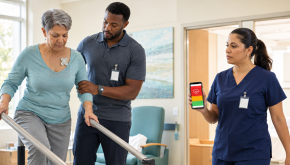
Recovery changes the care team, location and activity level. A handover is more useful when the next team can understand trends around the transition, rather than relying on a single discharge measurement.
For a suitable step-down or rehabilitation pathway, agree the monitoring plan before transfer. The receiving team verifies patient identity, device contact and gateway coverage, then reviews trends in the context of recovery and activity.
One synchronized physiological view
Selected for the care pathway
Synchronized chest signals
BLE data relay
Signal processing and fusion
Review, assess, respond
The clinical team selects suitable patients under the applicable intended use. PolyMonitor is attached to the chest with ECG electrodes, following the device instructions. Staff check skin contact and signal quality.
The chest unit acquires ECG, respiratory and other physiological signals. It connects to a gateway over BLE; the gateway relays the data to the REPHAEL cloud for processing and fusion. Agree connectivity, coverage and responsibility for interruptions at each site.
The team reviews synchronized signals and trends in the clinical interface, alongside bedside assessment and the care plan. Assign a responsible team, review schedule and escalation pathway before starting.
Interpret physiological trends alongside recovery, mobilization and the individual care plan.
Define ownership at the handover so that changes are reviewed by the receiving team.
Plan fleet allocation across stays and sites. Include handover, logistics and service coverage in the local cost assessment.
The intended benefits below describe the service design. Changes in outcomes, workload or cost require evaluation in the local care pathway.
Plan patient selection, connectivity and the clinical response with our team.