Select and fit
The clinical team selects suitable patients under the applicable intended use. PolyMonitor is attached to the chest with ECG electrodes, following the device instructions. Staff check skin contact and signal quality.


Care settings
See change between ward observations.
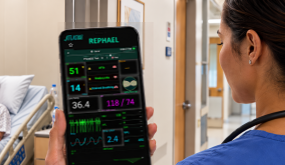
Ward teams care for many patients at once. Scheduled measurements leave intervals in the recorded picture, while each patient’s condition continues to evolve.
For suitable ward patients, the team fits PolyMonitor, verifies the connection and reviews REPHAEL trends alongside routine observations. A concerning change prompts clinical assessment under the ward’s escalation protocol.
One synchronized physiological view
Selected for the care pathway
Synchronized chest signals
BLE data relay
Signal processing and fusion
Review, assess, respond
The clinical team selects suitable patients under the applicable intended use. PolyMonitor is attached to the chest with ECG electrodes, following the device instructions. Staff check skin contact and signal quality.
The chest unit acquires ECG, respiratory and other physiological signals. It connects to a gateway over BLE; the gateway relays the data to the REPHAEL cloud for processing and fusion. Agree connectivity, coverage and responsibility for interruptions at each site.
The team reviews synchronized signals and trends in the clinical interface, alongside bedside assessment and the care plan. Assign a responsible team, review schedule and escalation pathway before starting.
Add the trajectory between observations to the bedside assessment.
A shared view supports handovers and review across the ward; response remains the responsibility of the assigned team.
A reusable fleet supplied as a service can serve successive patients. Evaluate service fees, electrodes, cleaning and staff time together.
The intended benefits below describe the service design. Changes in outcomes, workload or cost require evaluation in the local care pathway.
Plan patient selection, connectivity and the clinical response with our team.